 Jovian Labs
Porosity analysis of polished cross-sections
For metal additive manufacturing, castings, sintered parts and thermal spray coatings: upload micrographs of a cross-section and get the area porosity with its 95% confidence interval and relative accuracy, the pore size distribution, the largest pores with their position, the share of round and lack-of-fusion pores, eight quality checks and a PDF report.
Run it on Apify Example report (PDF)
Built for porosity, not adapted from a generic tool
- Prudent threshold. The lower of the Otsu threshold and the noise limit of the material, so that grain contrast and polishing scratches are not counted as pores when porosity is low. The report states how much the result moves if the threshold moves.
- Illumination correction for the darker corners of optical microscopes.
- Mounting resin excluded instead of being counted as a giant pore.
- Field statistics as in quantitative metallography: mean, 95% confidence interval, relative accuracy %RA and the number of fields needed for 10%.
Accuracy on synthetic cross-sections
| True porosity | Measured | Pores counted | Largest pore |
|---|---|---|---|
| 0.59% | 0.59% | 29 of 29 | 137.0 µm (true 138.6) |
| 2.17% | 2.19% | 104 of 104 | 152.7 µm (true 152.8) |
| 6.16% | 6.21% | 244 of 244 | 153.7 µm (true 154.0) |
With corners 35% darker, the illumination correction gives 2.17% for a true 2.14%, where a plain threshold reads 1.83%.
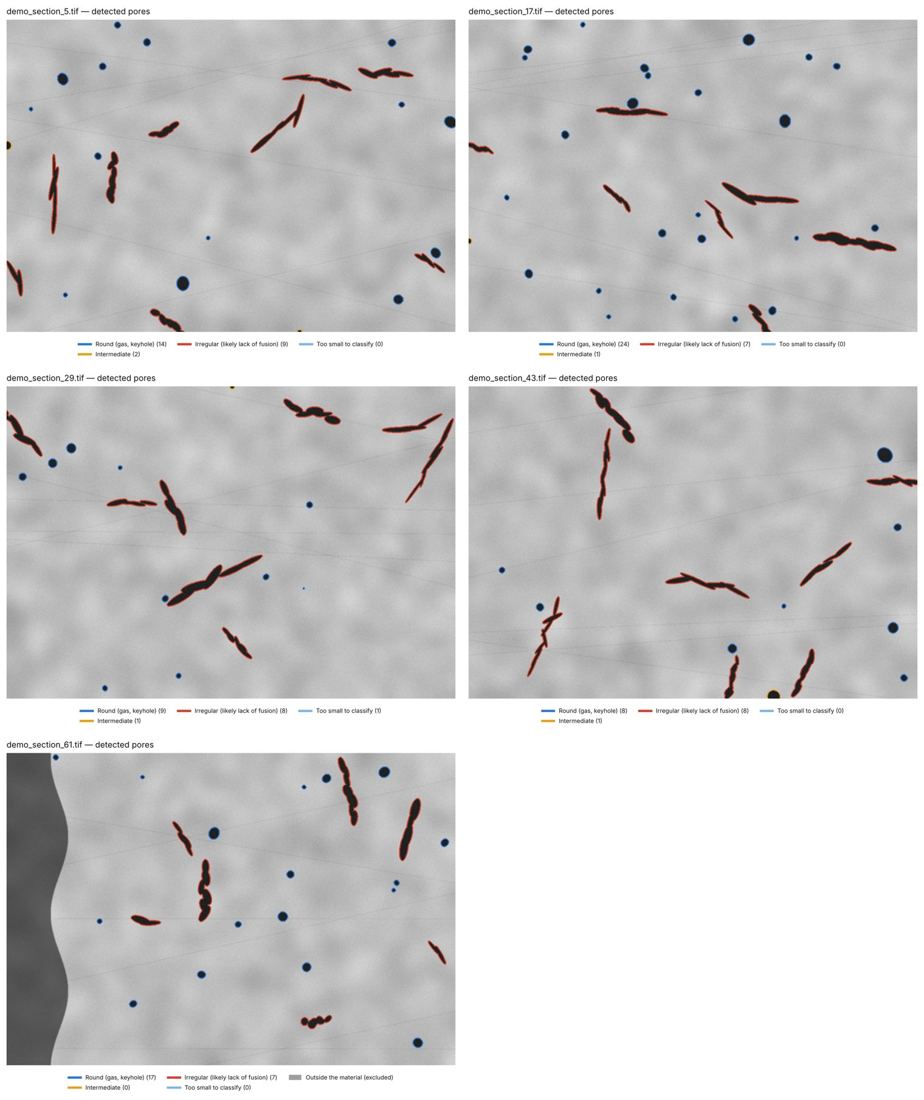
Control sheet from the demo
Questions
Which images can I use?
Polished, unetched cross-sections imaged in bright-field optical microscopy or SEM, with pores darker than the material (or tick the option for bright pores). Give the pixel size, the scale bar length, or send original Zeiss or Thermo Fisher SEM TIFF files.
How many fields?
Five or more, spread over the section. The report gives the relative accuracy reached and how many fields would bring it to 10%.
Does it separate gas pores from lack-of-fusion pores?
It types each pore from its roundness: round (gas or keyhole), irregular (likely lack of fusion) or intermediate. The thresholds are adjustable because they depend on the alloy and process; typing on a 2D section is indicative.
What about mounting resin and uneven lighting?
Large dark regions touching the field border are excluded from the material, and uneven illumination is corrected before thresholding.
What does it cost?
1 US dollar per image analysed, billed by Apify. Demo runs on synthetic sections are free.
Limits: oxides, inclusions or dark phases as dark as pores are counted as pores; preparation artefacts (pull-outs, smearing) are not detected automatically; a 2D section does not give volume porosity (use CT or the Archimedes method).